H2?
Case StudyNRPs Improve Drilling Efficiency by Reducing Mechanical Specific Energy
Across several wells and operators, WWT’s Non-Rotating Protectors (NRPs) demonstrated strong performance in reducing energy consumption and improving drilling efficiency.
Mechanical Specific Energy
Mechanical specific Energy (MSE) refers to the amount of energy needed to remove/drill a certain volume of rock. While different sources use varying formulas to calculate the MSE from surface parameters, the value is an indicator for drilling efficiency. A lower MSE value indicates that less energy is required to drill an equivalent volume of formation, reflecting higher overall drilling efficiency.
Case Studies
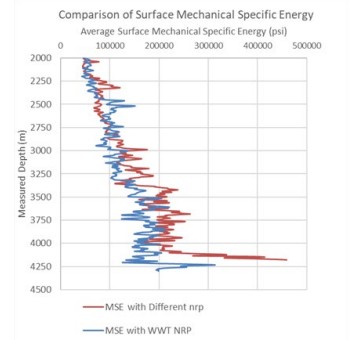
MSE with different torque reduction tools in SEA:
WWT NRPs performance was compared to other torque reduction tools on similar offset wells in the same field. WWT NRPs were superior on all fronts, including a lower overall MSE.
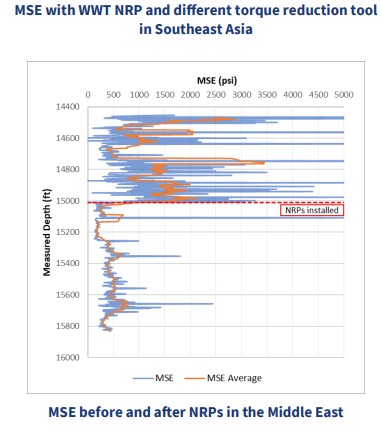
MSE drops between runs after NRPs are installed
High MSE values averaging around 1500 psi were recorded on a first drilling run without WWT NRPs. A significant drop in MSE was recorded when WWT NRPs were used on the second run, averaging around 500 psi throughout the run.
MSE decreases as WWT NRPs gradually enter hole in SEA
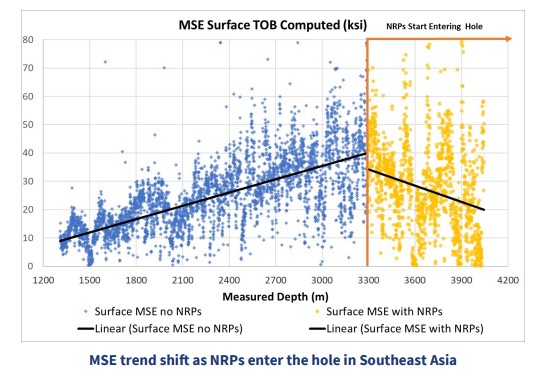
As WWT NRPs start entering the hole at around 3,300m, a shift in MSE trend was recorded. Overall MSE decreased as NRPs covered the critical areas despite reaching a deeper section where drilling usually becomes more difficult.
MSE trend shift as NRPs enter the hole in Southeast Asia MSE with WWT NRP and different torque reduction tool in Southeast Asia MSE before and after NRPs in the Middle East.