Non-Rotating Protectors in Completion Operations
Client challenge
During completion operations, torque levels were nearing critical thresholds, prompting consideration of a sidetrack due to trajectory concerns. Both the work string and frack string approached torque limits,
with particular attention on ensuring torque remained below 52,000 ft-lbs to safely release the lower completions.
Our solution
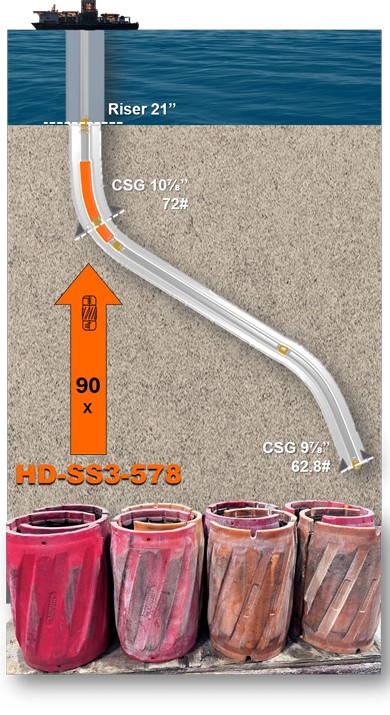
NRPs were used to locally reduce friction factors, effectively lowering and managing torque during completions. The protectors also helped reduce pick-up weight and ensured operations remained within tensile limits. Over the course of a month, 90 x HD-SS3-578 protectors were strategically
installed on 5⅞” drill pipe while executing various completion operations.
Results
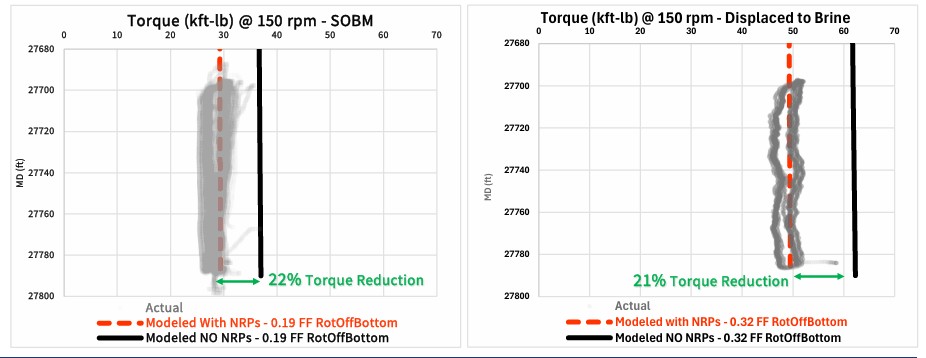
NRPs significantly enhance drilling performance by reducing torque and hook load. In displacement scenarios using synthetic oil-based mud and brine, NRPs lowered torque by 22% and 21%, respectively.
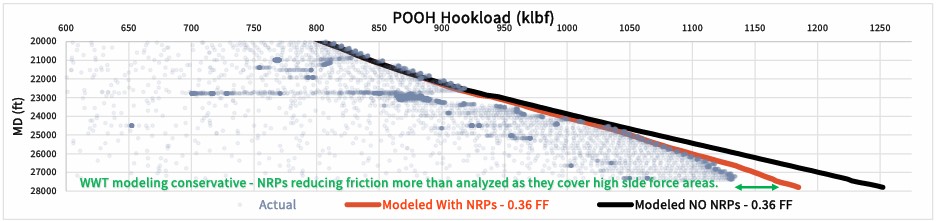
Additionally, NRPs effectively minimized axial drag during completions, leading to smoother set-down weights and improved axial load transfer. This is evidenced by a reduction in hook load of 120klbf when
NRPs were used. Completion operations in a deepwater well exceeding 27,000 feet come with a unique set of technical challenges—especially when deploying smaller equipment. Excessive rotary torque can
easily surpass the drill pipe’s torsional limits, while the extreme depth complicates weight distribution, making it difficult to stay within tensile thresholds. These conditions demand precise torque management and optimized load transfer to ensure safe and efficient execution.
The completions process involved a series of coordinated operations including drill pipe pickup, mud conditioning and packer installation to prepare the well. TCP guns were deployed for perforation, followed by cleanout and circulation to ensure wellbore integrity. A sump packer was installed, and screen assemblies were run to support gravel pack operations, which were executed to finalize the well for production.
A back model using actual torque values was conducted with synthetic oil-based mud, followed by displacement to completion brine. For synthetic mud, the friction factor (FF) was 0.19, and torque fluctuated around 29 kft-lb with 90 NRPs installed. Had NRPs not been used, torque would have reached 37 kft-lb, indicating a 22% reduction. After displacing to brine, the FF increased to 0.32, with torque around 49 kft-lb; simulated torque without NRPs would have reached 62 kft-lb, indicating a 21% reduction.
The hook load analysis demonstrates the SS3 model NRPs effectively reduce axial drag during completions. Simulations without NRPs indicated significantly higher pick-up weights, whereas those with NRPs showed improved axial load transfer and reduced drag. NRPs lowered hook load from 1,252 klbf to 1,132 klbf by providing stand-off with a low-friction polymer sleeve. Actual hook load measurements closely aligned with NRP-adjusted simulations, confirming that NRPs delivered measurable drag reduction and enabled smoother set-down weights.